PBL Logo - click here to return to homepage spacer
Get QuoteSubmit SamplesTest and Report spcr
 
 
Home >> Medical Device Services >> Preclinical Biocompatibility >> Assessing Biocompatibility >> Test Planning (BioPT)

ASSESSING BIOCOMPATIBILITY: Biocompatibility Planning Tool (BioPT)

Intro to Biocompatibility Testing | Test Planning (BioPT) | Biological Test Methods | Analytical Testing Of Biomaterials


Device companies spend a tremendous amount of time, money and energy developing and implementing biocompatibility testing programs. Pacific BioLabs has developed the BioPT (Biocompatibility Planning Tool) to guide you through the basic concepts of device testing and to help manufacturers select testing procedures to comply with current regulatory requirements.

The chart below gives you an overview of the process. Follow the links to get more detail on each specific topic. Click here for information on materials characterization & analytical testing of devices.
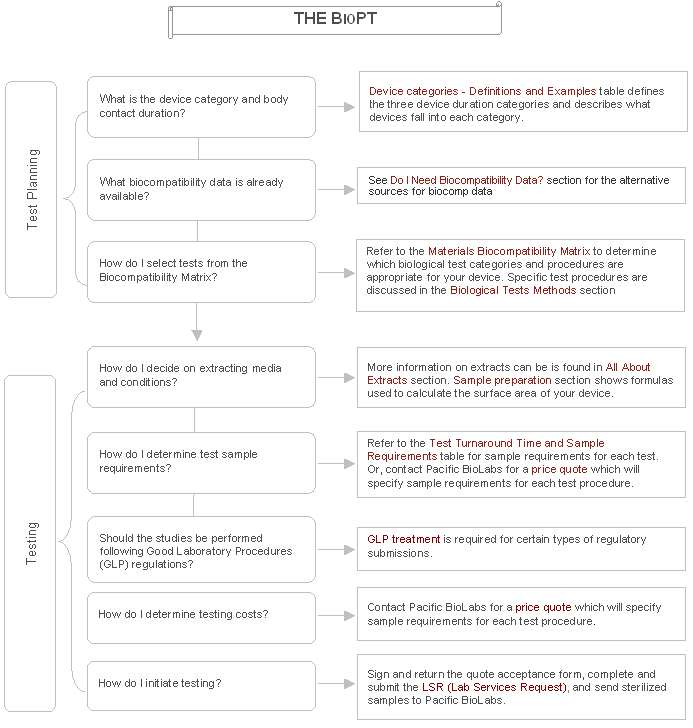
flow chart

    Expand All | Collapse All

  • All About Extracts

    • Medical device biocompatibility problems are most often caused by toxins that leach out of the device into the surrounding tissues or body fluids. So in the laboratory, extracts of device materials are often used in assessing biocompatibility. These extracts are generally prepared using exaggerated conditions of time and temperature to allow a margin of safety over normal physiological conditions.

      Analytical extraction studies allow the chemist to identify and quantitate specific leachable moieties. This data can in turn help the device toxicologist or risk assessor determine the worst case scenario for patient exposure and the risk to patient health.

      Extracts are also used in many of the biological tests specified by ISO 10993. Table 1 lists the most commonly used extracting media. For most devices, only saline and vegetable oil extracts are needed. 

      Extracts are selected on the basis of the biological environment in which the test material is to be used. A saline (SCI) extract approximates the aqueous, hydrophilic fluids in the body. It also permits the use of extreme temperatures in preparing the extracts, thus simulating certain sterilization conditions.

      Tissue culture media may even more closely approximate aqueous body fluids, but cannot be used for high temperature extractions. Vegetable oils are non-polar, hydrophobic solvents and simulate the lipid fluids in the body. For technical reasons, DMSO extracts are often used in certain genotoxicity and sensitization tests. Two other common extracting media – Alcohol in SCI and PEG – should be used only if they approximate the solvent properties of drugs or other materials that will contact the device during its normal use.

      Extraction conditions (temperature and time) should be at least as extreme as any conditions the device or material will encounter during sterilization or clinical use. Generally, you will want to choose the highest extraction temperature that does not melt or fuse the material or cause chemical changes. To provide some margin of safety for use conditions, Pacific BioLabs recommends an extraction condition of at least 50°C for 72 hours. For devices that are susceptible to heat, an extraction condition of 37°C for 72 hours may be acceptable. Table 2 lists common extraction conditions.

      TABLE 1: Extracting Media
      Sodium Chloride for Injection, USP (SCI)
      Vegetable Oil
      1:20 Alcohol in SCI
      Polyethylene Glycol 400 (PEG)
      DMSO
      Clinically Relevant Solvents


      TABLE 2:  Extraction Conditions
      37°C for 24 hours
      37°C for 72 hours
      50°C for 72 hours
      70°C for 24 hours
      121°C for 1 hour
      Other Conditions (justification required)


  • Sample Preparation

    • The simplest method for determining the surface area of a device is usually to use the CAD program from the design engineering group. Typically the surface area can be calculated with a just a few keystrokes. Alternatively, you can calculate the surface area using the equations below. Or you can submit a sample device and/or an engineering drawing to Pacific BioLabs, and our staff will perform the calculations.

      Typically, the standard surface area of your device is used to determine the volume of extract needed for each test performed. This area includes the combined area of both sides of the device but excludes indeterminate surface irregularities. If the surface area cannot be determined due to the configuration of the device, a mass/volume of extracting fluid can be used. In either case, the device is cut into small pieces before extraction to enhance exposure to the extracting media. In some cases, it is not appropriate to cut the device; such devices are tested intact.

      The Test Turnaround Time and Sample Requirements table lists the amount of sample required for many procedures. Generally, we recommend using the ratio of sample to extracting media specified in ISO 19993-12 (i.e. either 6 cm²/mL or 3 cm²/mL, depending on the thickness of the test material). For some types of materials, the ratio used for USP Elastomeric Closures for Injections (1.25 cm² per mL) is preferred.

  • Formulas For Surface Area Calculation

    • Device Shape
      Formula
      Square or Rectangle A = L x W
      Hollow Cylinder A = (ID + OD) π x L
      Disk A (one side) = π r²
      Ellipse A = (π x X x Y)/4
      Regular Polygon A = (b x h x n)/2


      Device Shape
      Formula
      Solid Cylinder (including ends) A = (OD x π x L) + (2 π r²)
      Triangle A = (b x h)/2
      Sphere A = 4 x π r²
      Trapezoid A = (h x [p + q])/2
      Circular Ring 4 π²Rrrc


      Legend

      A = surface area   ID = inner diameter>
      OD = outer diameter   L = length
      W = width   R = radius
      RR = ring radius (circular ring)   rc = cross section radius (circular ring)
      X, Y = longest and shortest distances through the center of an ellipse   π = 3.14
      h = height   b = base length
      p, q = length of the parallel sides of a trapezoid   n = number of sides of a polygon
      r0 = ½ OD  

      ri = ½ ID

  • ISO 10993 - Biological Evaluation Of Medical Devices: Listing Of Individual Parts

    •  Part  Topic
      1 Evaluation and Testing
      2 Animal Welfare Requirements
      3 Tests for Genotoxicty, Carcinogenicity, and Reproductive Toxicity
      4 Selection of Tests for Interactions with Blood
      5 Tests for Cytotoxicity – In Vitro Methods
      6 Tests for Local Effects after Implantation
      7 Ethylene Oxide Sterilization Residuals
      8 Selection and Qualification of Reference Materials for Biological Test
      9 Framework for Identification & Quantification of Potential Degradation Products
      10 Test for Irritation and Sensitization
      11 Test for Systemic Toxicity
      12 Sample Preparation and Reference Materials
      13 Identification and Quantification of Degradation Products from Polymers
      14 Identification and Quantification of Degradation Products from Ceramics
      15 Identification and Quantification of Degradation Products from Coated and Uncoated Metals and Alloys
      16 Toxicokinetic Study Design for Degradation Products and Leachables
      17 Establishment of Allowable Limits for Leachable Substances
      18 Chemical Characterization of Materials*
      19 Physicochemical, Mechanical and Morphological Characterization (Draft)
      20 Principles and Methods for Immunotoxicology Testing of Medical Devices (Draft)


      * = The United States ISO Member Body, ANSI/AAMI, is considering a version of this document for use in the U.S. 

  • Device Categories – Definitions & Examples

    • Device Categories

      Examples

      Surface Device

      Skin

      Devices that contact intact skin surfaces only. Examples include electrodes, external prostheses, fixation tapes, compression bandages and monitors of various types.

      Mucous membrane

      Devices communicating with intact mucosal membranes. Examples include contact lenses, urinary catheters, intravaginal and intraintestinal devices (stomach tubes, sigmoidoscopes, colonoscopes, gastroscopes), endotracheal tubes, bronchoscopes, dental prostheses, orthodontic devices and IUD’s.

      Breached or compromised surfaces

      Devices that contact breached or otherwise compromised external body surfaces. Examples include ulcer, burn and granulation tissue dressings or healing devices and occlusive patches.

      External Communicating Device

      Blood path indirect

      Devices that contact the blood path at one point and serve as a conduit for entry into the vascular system. Examples include solution administration sets, extension sets, transfer sets, and blood administration sets.

      Tissue/bone/dentin communicating

      Devices communicating with tissue, bone, and pulp/dentin system. Examples include laparoscopes, arthroscopes, draining systems, dental cements, dental filling materials and skin staples.  This category also includes devices which contact internal tissues (rather than blood contact devices).  Examples include many surgical instruments and accessories. 

      Circulating blood

      Devices that contact circulating blood. Examples include intravascular catheters, temporary pacemaker electrodes, oxygenators, extracorporeal oxygenator tubing and accessories, hemoadsorbents and immunoabsorbents.

      Implant Device

      Tissue/bone

      Devices principally contacting bone. Examples include orthopedic pins, plates, replacement joints, bone prostheses, cements and intraosseous devices.

      Devices principally contacting tissue and tissues fluid. Examples include pacemakers, drug supply devices, neuromuscular sensors and stimulators, replacement tendons, breast implants, artificial larynxes, subperiosteal implants and ligation clips.

      Blood

      Devices principally contacting blood. Examples include pacemaker electrodes, artificial arteriovenous fistulae, heart valves, vascular grafts and stents, internal drug delivery catheters, and ventricular assist devices.

      Non-Contact Device

      n/a

      These are devices that do not contact the patient's body directly or indirectly. Examples include in vitro diagnostic devices. Regulatory agencies rarely require biocompatibility testing for such devices.


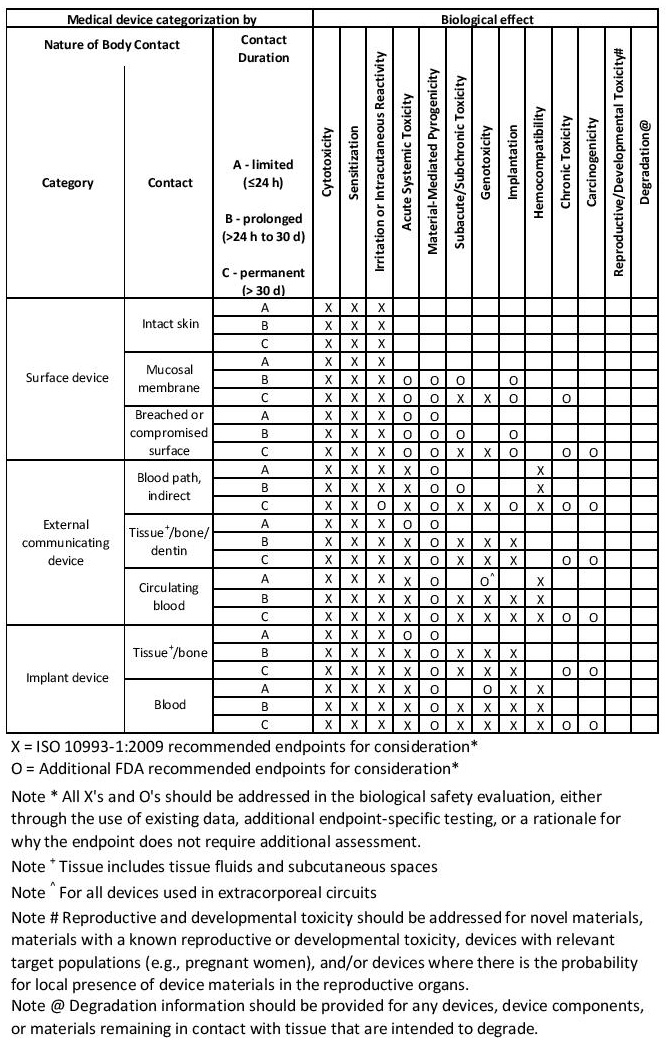
  • ISO Materials Biocompatibility Matrix

    • biocompatibility matrix
      This table is only a framework for the development of an assessment program for your device and is not a checklist.
      • = ISO Evaluation Tests for Consideration 
      F = Additional Tests which may be required  for US submissions
        Note1  Tissue includes tissue fluids and subcutaneous spaces
      Note2  For all devices used in extracorporeal circuits
      Note3  Depends on specific nature of the device and its component materials
      Consult with the FDA before performing any biocompatibility testing if you are submitting an IDE or you have a device/drug combination.

  • Test Turnaround Time And Sample Requirements

    •                                     REQUIREMENT

      TEST NAME

      SAMPLE AMOUNT(1)

      TURN AROUND (in weeks)

      Surface Area (cm2)

      Weight (gram or mL)

      Cytotoxicity

      USP Agar Overlay

      1 cm² x 2 pieces

      2

      2 – 3

      USP MEM Elution

      1 cm² x 2 pieces

      USP Direct Contact

      60(2)

      ISO Agar Overlay

      1 cm² x 3 pieces

      ISO MEM Elution

      1 cm² x 3 pieces

      ISO Direct Contact

      60(2)

      line

      Sensitization

      Murine Local Lymph Node Assay (LLNA)

      120 cm²

      8

      5

      Maximization Test

      240(2)

      16

      8

      Closed Patch Test

      1 in2 x 130 pieces

      60-80

      8 – 9

      line

      Irritation

      USP Intracutaneous Test

      60(2)

      4

      3

      ISO Intracutaneous Test

      60(2)

      4

      ISO Dermal Irritation

      60(2)

      10

      3 – 4

      FHSA Primary Skin Irritation

      NA

      10

      ISO Ocular Irritation

      60(2)

      10

      3 – 4

      FHSA Primary Eye Irritation

      NA

      10

      Mucous Membrane Irritation

      60(2)

      Varies

      Varies

      line

      Systemic Toxicity

      USP Systemic Injection Test

      60(2)

      4

      3

      Material Mediated Pyrogen Test

      10 devices/540 cm²

      4

      2 - 3

      line

      Subchronic
      (14 – 180 Days)

      Intraperitoneal Test

      12 devices

      55

      6 – 7

      Intravenous Test
      Implant Tests

      12 devices (4)


      Varies

      Other Procedures

      Varies

      Varies

      Varies

      line

      Genotoxicity

      Ames Test

      120(2)

      8

      6

      Mouse Lymphoma Assay

      900(2)

      60

      13 – 15

      Mouse Micronucleus Assay

      120(2)

      8

      11

      Chromosomal Aberration Test

      120(2)

      8

      12

      line

      Implantation

      Implantation Test
      Acute 7 Day
      Subchronic 14 – 180 Day
      Chronic > 180 Day

      12 strips 1 x 10 mm


      3
      7 – 28
      54

      – Histopathology

      NA

      3 – 4

      line

      Hemocompatibility

      Hemolysis – Direct Contact (duplicate)

      NA

      4

      2

      Hemolysis – Direct Contact (triplicate)

      3 devices

      6

      2

      Hemolysis – Sample Extract (duplicate)

      120(2)

      NA

      2

      Hemolysis – Sample Extract (triplicate)

      3 devices

      NA

      2

      In Vivo Thrombogenicity

      6 – 2 ½ “ long pieces

      10 - 12

      In Vitro Platelet Aggregation Assay

      240(2)

      10

      4 - 6

      In Vitro Hemocompatibility Assay

      150(2)

      10

      4 - 6

      Partial Thromboplastin Time (PTT),
      Prothrombin Time (PT)

      60(2)

      4

      4 - 6

      Complement Activation

      120(2)

      2

      4 - 7

      line

      Chronic

      Long Term Implant

      Inquire

      Inquire

      Lifetime Toxicity

      Inquire

      Inquire

      line

      Carcinogenesis

      Lifetime Toxicity

      Inquire

      Inquire

      line

      Analytical Tests

      USP Physicochemical Tests

      720

      NA

      2

      Infrared Scan

      5 cm x 1 cm (min.)

      NA

      2

      Other Procedures

      Inquire

      Inquire


      (1) - Sample requirements based on surface area calculations. The weight of the device may be used if the surface area cannot be calculated.
      (2) - Double these amounts for materials < 0.5 mm in thickness.
      (3) - Depends on duration of implant.
      (4) - 15 strips per time point, each strip 1 mm x 10 mm, sample should be supplied by Sponsor in specified size, separately packaged and sterilized, ends should be smooth and rounded.

Download pritable version of our booklet Assessing Biocompatibility - A Guide for Medical Device Manufacturers (PDF).